Transforming how hotel partners describe their offering, enabling structured facilities data from partners, unlocking clearer discovery for members and scalable value for the business.
Year
2024
The team
Tech team
Various product squads
Editorial
Global operations
Legal
My role
Responsible for research, facilitation, strategy, and end-to-end design (supply domain)
Scope
Partner Portal (Supply)
Hotel facilities level (excluding room amenities)
Sale pages & filters
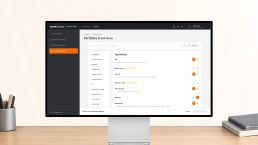
Facilities & Services transformed how hotel data is captured, structured, and used across Secret Escapes.
I led the design of a supply-side system that enables partners (hotels) to input and maintain facilities data, turning fragmented information into reliable signals used across filters, sale pages, and internal tools.
This work mattered because it improved customer decision-making, reduced operational overhead, and created a scalable data foundation for the business.
Context & Challenge
This project had been sitting in the tech backlog for over a year, the business knew it was important, but without a clear design direction or stakeholder alignment, it hadn’t moved. I picked it up as the sole designer and made it my first priority to understand why it had stalled.
Facilities data is a key decision driver for travellers and it was inconsistent, unstructured, and often missing. This made hotels harder to find and compare.
The problem spanned multiple teams and systems:
- Fragmented and unreliable existing data
- Inconsistent definitions across regions and hotel types
- Heavy reliance on free text and editorial workarounds
- Legal and accessibility considerations
- Data needed to power multiple downstream experiences, not a single page
The challenge was to improve data quality without increasing internal workload, while scaling across a global supply base.
Strategy & Decisions
I approached this as a data and behaviour problem, not just a UI task. Facilities data was fragmented, free-text, and manually maintained, making it impossible to surface consistently to members.
Three models were on the table: a 3rd party content provider, an internal editorial process, and partner self-serve via the Partner Portal. Each had real trade-offs around cost, accuracy, and operational load.
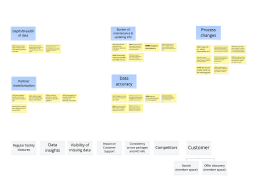
To move the decision forward, I designed and facilitated a design sprint, bringing together 10+ stakeholders across Product, Ops, Editorial, Legal, and Tech. I ran expert interviews, HMW voting, MoSCoW requirements prioritisation, and concept sketching sessions. I contributed ideas while facilitating, and used the sprint outputs to build the business case for a single direction.
Key decision: Partner-led model, hotels input and maintain their own facilities data directly via the Partner Portal.
Why it won: accuracy at the source, scalability across a global portfolio, reduced SE operational dependency, clear data ownership.
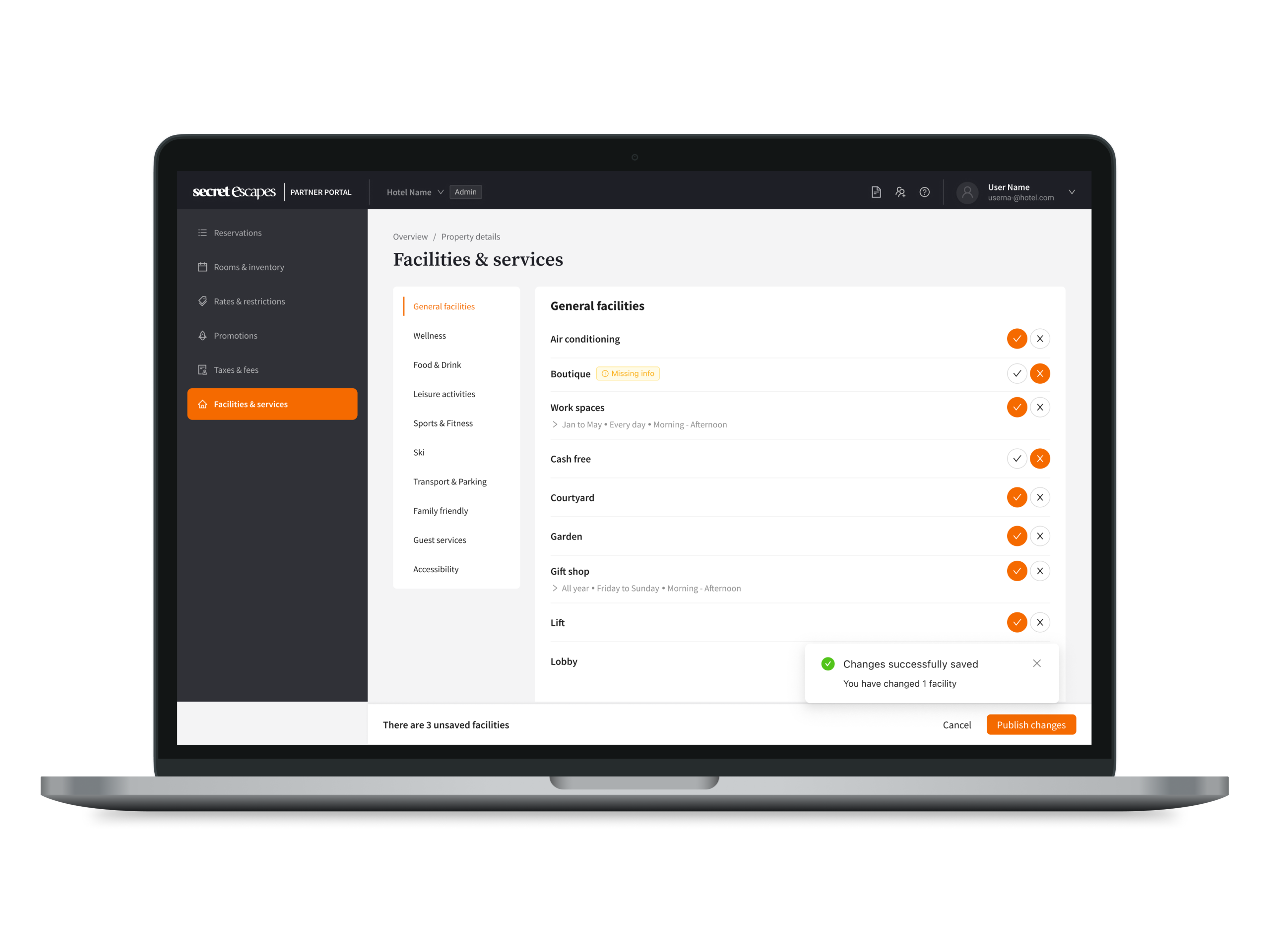
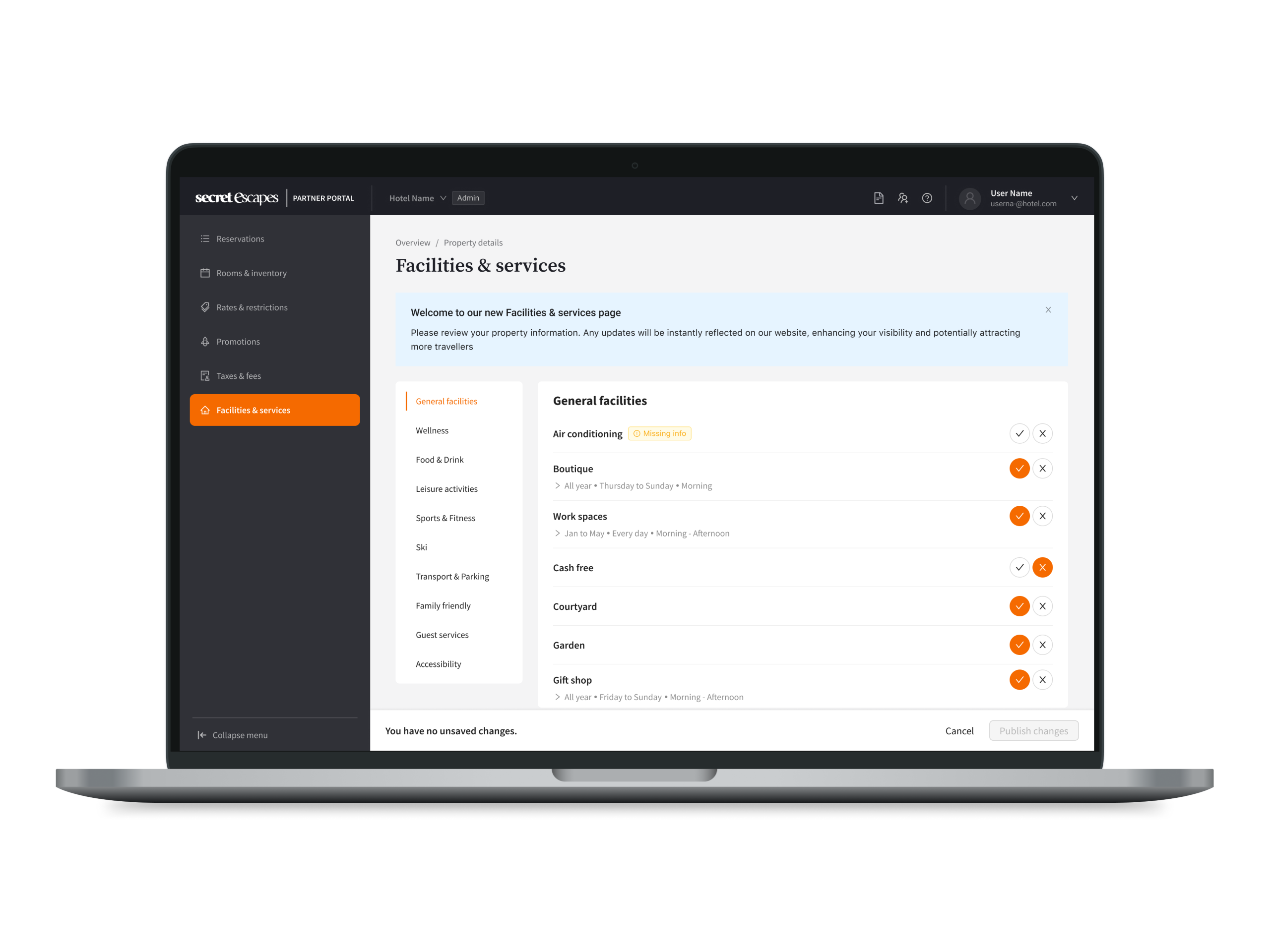
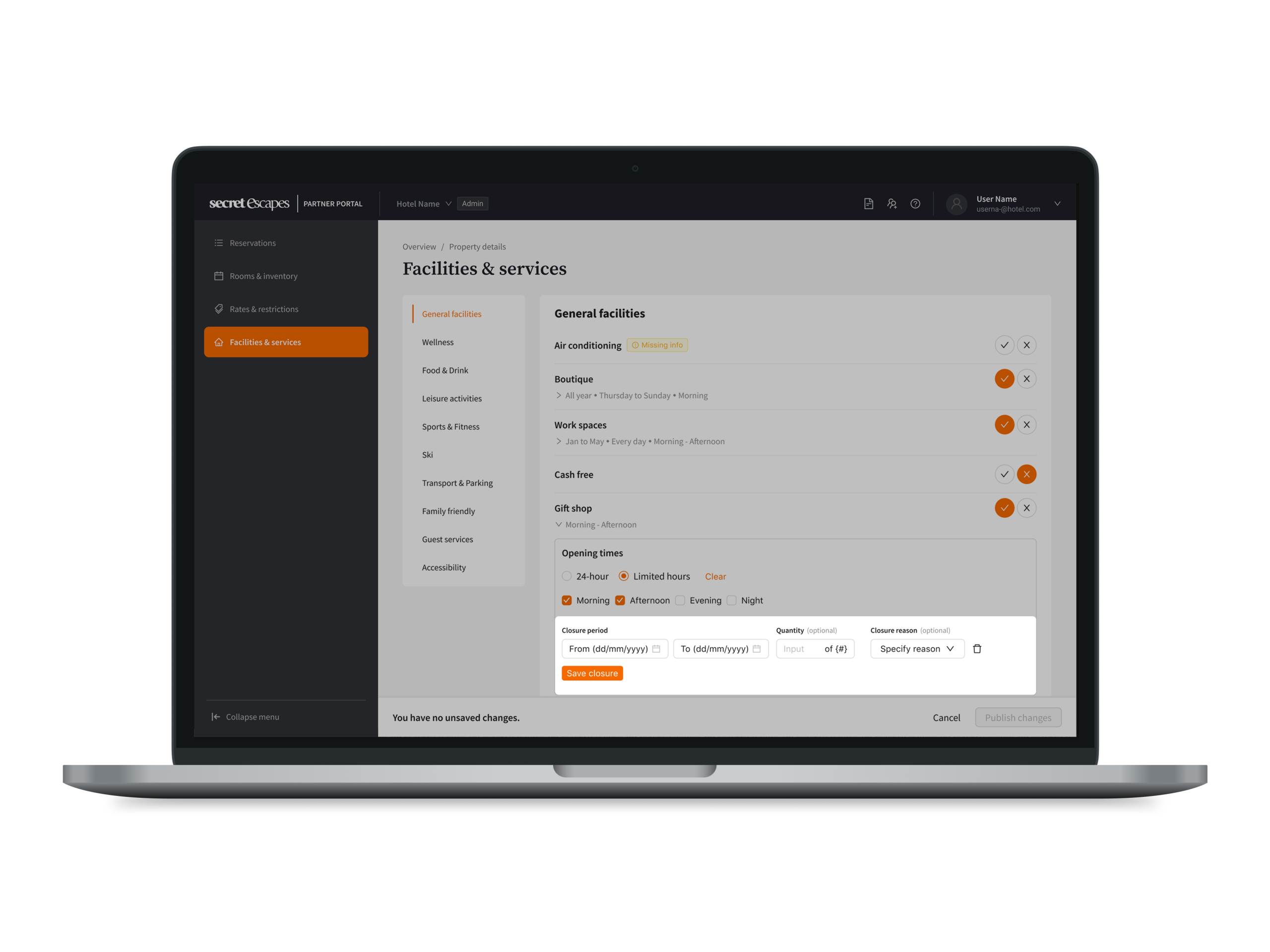
What it demanded from the design: partner adoption couldn’t be assumed. The UX had to be good enough that hotels would actually complete it, which meant strong defaults, inline validation, guided onboarding, and visible publishing feedback.
Execution
The solution focused on designing a scalable system, not just an interface. Execution followed three phases.
1. Sprint to scope
Eight concept sketches from across the business, HMW voting, and MoSCoW prioritisation produced a clear MVP scope and a set of requirements I could take directly into design. This also gave Tech and Product confidence to commit resource.
2. Structure before screens
We defined, with the tech lead and PM from supply, the data taxonomy first, facility categories, attribute types, edge cases like closures and seasonal availability. This reduced free text, created consistent data signals, and made downstream use in filters and sale pages possible.
3. Designing for completion
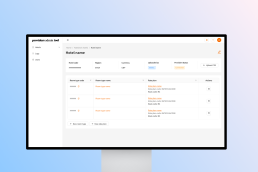
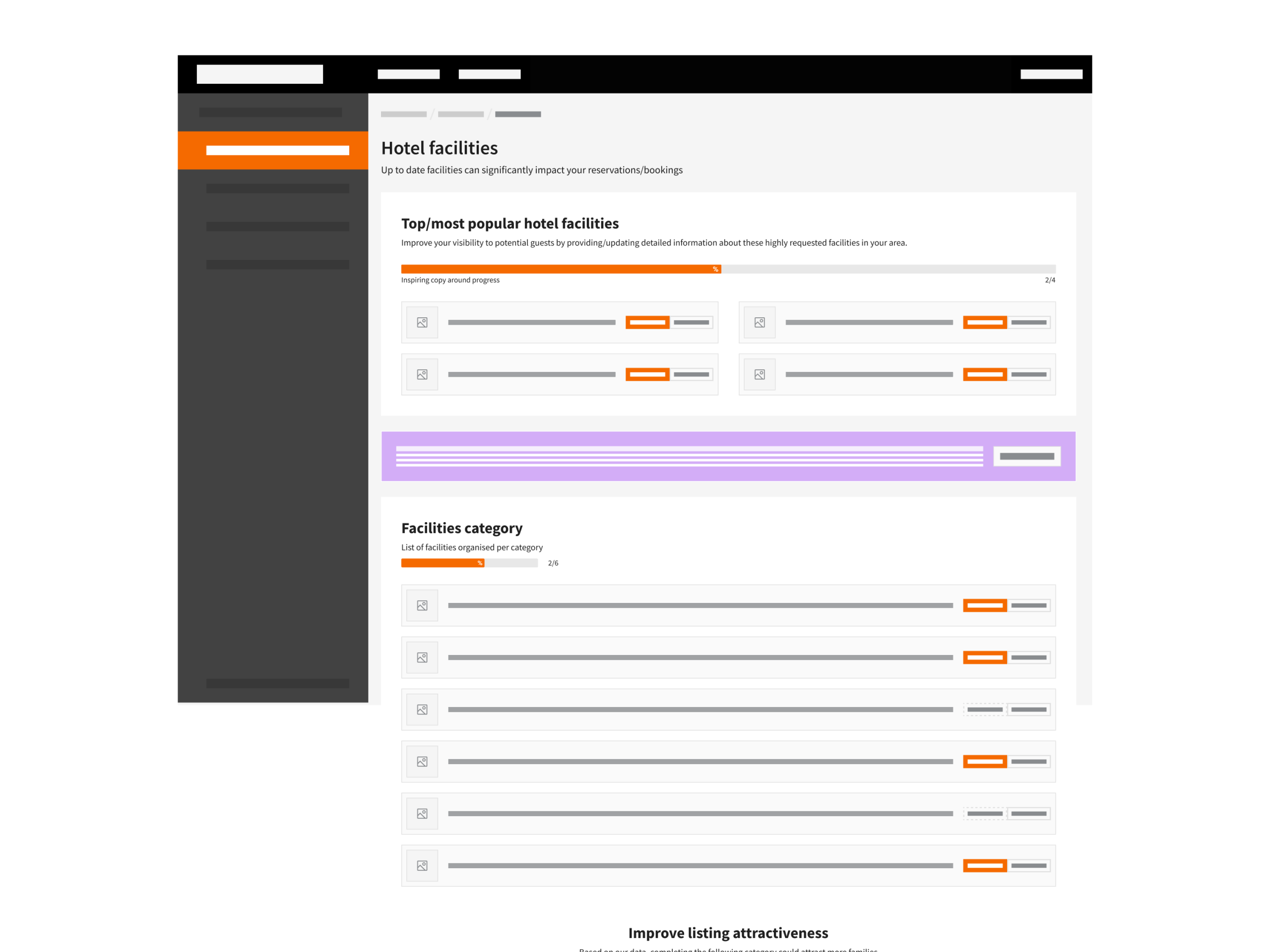
Progressive disclosure, data-driven defaults, inline validation, and onboarding guidance were not nice-to-haves, they were the mechanism by which the partner-led model could actually work. Key states designed: onboarding, default populated state, editing with live feedback, closures, and missing info prompts.
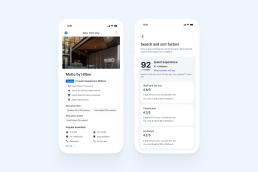
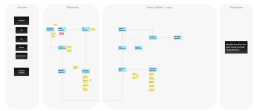
Facilities data flowed via SalesForce into two customer-facing surfaces, the search filter and the hotel sale page, connecting supply input directly to member discovery.
Outcomes & impact
This work shifted facilities data from fragmented and manually maintained to a structured, scalable system used across the product. Partner-submitted facilities flowed directly into two customer-facing surfaces, the search filter and the hotel sale page.
Supply input → member discovery
~78%
Facilities data available across live and pre-live hotels
92%
of top facilities consistently captured
69%
coverage across extended attributes (beyond the core must-haves)
100%
of deals with facilities filter available (previously blocked by data quality)
Operational impact
- New hotel deals consistently launched with complete facilities data
- Reduced reliance on manual editorial enrichment
- Introduced clearer ownership between partners and internal teams
What changed
Facilities data moved from:
- Inconsistent → structured
- Manual → partner-owned
- Single-use → reusable across the platform
System impact
- Created a single source of truth for facilities data
- Enabled reuse across multiple downstream systems via API
- Unlocked future extensions (e.g. room-level amenities)
Operational learnings
Reactivations exposed gaps in process:
- 42 hotels relaunched without facilities data
- Introduced tracking and ownership conversations via Commercial teams
- Explored enforcement mechanisms (not fully feasible)
Highlighted that data quality depends on process, not just product